Translate this site:


Traducir esta sitio web.

Feb 25, 2009

St. James Episcopal Church, built 1895

208 North Fourth Street
The charter of St. James was founded in 1844, this building was built circa 1895. One source has it that Margaret Taylor, wife of 12th President Zachary Taylor, was one of the founders of the church.

I love the red brick, so rich in color, it give such character to this Gothic Revival style church. The red clay uses in making the brick may have come from Mississippi or parts of Louisiana where it is found.

 St. James stands on an old antebellum home site, 
which home was built about 1855.

The Plaque reads: This building stands on the site of the above pictured antebellum home built about 1855. Saint James Church purchased the property in 1922. Mary Fisher Maxwell, daughter of a former owner, donated her home on the adjacent property to Saint James in 1949. Yielding to the needs of a changing era. Both houses were replaced by the present structure in 1967. This plaque is given to the Glory of God and in Loving memory of Mary Fisher Maxwell.


Plaque reads:
ST. JAMES EPISCOPAL CHURCH - The congregation first organized 1819, received their charter as St. James Church in 1844. The second church, of Gothic Revival style, was completed in 1895 Mrs. Zachary Taylor was an early member. ~end~

Zachary Taylor settled his wife in Baton Rouge when he went off to Mexico to fight in the Mexican-American war.  They moved into the commandant's house of the U.S. Garrison in Baton Rouge.
There is a good bio on Zachary Taylor here. He when on to become the twelfth U.S. President 1869-1877.

Image of all the President's here.


Baptismal Font
The font was given to St. James by the family of General Thomas Williams commanding officer of the occupying Union forces of Baton Rouge in appreciation for their (or Baton Rouge's) kind treatment of Williams when he was mortally wounded and later in his death. General Williams attended St. James during his time in Baton Rouge.

Homepage

Feb 13, 2009

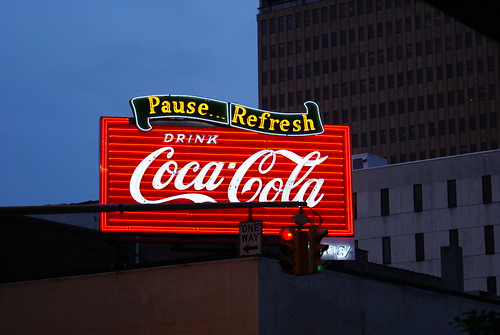
The Third Street Coca Cola Sign


Thanks to a visitor to the blog I was reminded that Willis-Liggett Drugstore was under that sign and had a soda fountain and that it operated as recently as 1981. 

A visitor to this blog writes that she has the old grill from the soda fountain in her home, her dad bought it in 1981 when it closed.

There was a Coca-Cola sign, almost exactly like the one downtown in Hollywood, California, on Hollywood Blvd., but is long gone. 


Feb 5, 2009

Bates & Thigpen, men clothier, since 1924

Bates and Thigpen Men's Clothier
335 Third Street

Next to the Romaine building.

Since 1924,

operated today by third generation Bates since founding.

Lingering Signs From the Past

 Signs painted on buildings, etc.

 "Kodak photography • framing • gallery"

I really love this sign, I hope that it is never 
painted over, it speaks of a by gone era.
[Note: this sign is now painted over]


FROST - BARBER INC.
OFFICE EQUIPMENT AND STATIONARY
CONTACT INTERIOR DESIGNER - Ph. xxx-xxxx (unreadable)
[Frost Barber Inc. is still going strong today, serving the community for over 50 years.]

Goudchaux Department store

This sign is still in place for Goudchaux, it appears to be made of little tiles.

Homepage

Feb 3, 2009

Florence Coffee House - 1850

 130 Main Street between Lafayette and River Road

The Florence Coffee House was built in 1850 by Johan and Lucas Florence to replace an earlier building which had been destroyed by fire ref. On July 24, 1850, the Florence brothers signed a contract with Nelson Potts for the building's construction. The cost was $1,225. In 1852 the property was sold to Matteo Dorice for $2,500 and since then there has been a long succession of owners. Until the Civil War the building remained in use as a coffee house. Since the war it has served a variety of uses, being at different times a grocery, a cobbler shop, a boardinghouse, and a private residence. The owners before the present one restored the building in 1971.


Those arched window frames could be extremely old
perhaps early 20th century.

Both above and below photos are of the
end of the drive
-thru  seen in front.

Louisiana State Capitol, Baton Rouge


State Tourism Site
Photo Gallery (an emporis.com page)

Feb 2, 2009

Water Company Standpipe, 1888


131 Lafayette Street

The Standpipe, which is 121 years old, stand 100 feet in height and is 15 feet in diameter; liquid capacity is 145, 750 gallons. Built in 1888 the Standpipe was placed on the National Register of Historical Places December 4, 1973. 

Architect, builder, or engineer: John H. Wood, E. Smedley.

This is the best picture of the standpipe that you will see on the Web, the whole pipe at such an elevated angle, with the Mississippi and barge's in the background. 


Map

AWARD READS:
AN AMERICAN WATER COMPANY LANDMARK
SIGNIFICANT IN THE HISTORY OF PUBLIC WATER SUPPLY
DESIGNATED BY
AMERICAN WATER WORKS ASSOCIATION

The Standpipe received an award from the "American Water Works Association" for significance in the history of public water supply, date of the award is unknown to me.

Last time I was at the standpipe I looked for the award and didn't find it, it has been removed, which I assume  it was because of the last paint job. A lot of people today hold nothing dear of historical nature.


Jan 28, 2009

Harney Hackett House, 813 North Street, built 1895

 Harney Hackett House, 813 North Street -1895
I was happy to see that this piece of B.R. history being preserved, they took the majority of the paint down to the wood, a lot of work for this young man and his dad hired to do the work. This was a rental from way back, the historical usage was a rent house. There was a latter addition to the house (left above scaffolding, painted area).


This now commercial building is the third house from the corner beside the MLK (I-110), it is two doors down from The Potts House*, which is on the corner and for sale. There is a mirrored-plan house (duplicate, but mirrored) of this one next door in between the Hackett House and the Potts House.

*Nelson Potts was a master brick mason in the 19th century.

The store at 801-803 North Street, left of photo-next door, was built about 1883. This is said to have been a warehouse and residence, used many years by the Hackett family, whose business was refinishing furniture. Source: crt.state.la.us/hp/nhl/parish17 (link removed, broken)

Jan 26, 2009

Baton Rouge City Park


Bath House of the, now covered up, pool.

.


Ollie Steele Burden planted Live Oaks
in City Park.
.

 City Parks' Luminary's (two of them), with columns of the pagoda-style building of the old carousel that used to be in the park. Later they were used on the Picnic Hill Pavilion when built in 1955, but originally, were the columns' of the 19th century Baton Rouge City Market. LSU used 12 columns all together.
.

The City Park Carousel


Old Baton Rouge Market Columns

About the Old City Market [an excerpt]: A major center of activity was in the old Baton Rouge Market. The market was first located on North Boulevard at the south end of Third Street and later, in 1854, moved to the site of the existing Municipal Building, St. Ferdinand and North Boulevard.
Although the major business of the market was to sell meats and produce during the hours of 2 a.m. until 8 a.m., the market also served coffee and doughnuts at all hours, thus attracting a crowd eager for the latest political and social news. In addition the old market was used for all-night dances on special holidays. Excerpted from, Source
.
[Post note: The plaques are on a bad angle because at the time I didn't know how to turn off the flash on my camera yet and I had the evening sun to my back. I hope one day to go back for a redo.]

Jan 24, 2009

Discovery of Area and founding of City, Parish, and State

I TRIED TO PUT THE FOLLOWING IN CHRONOLOGICAL ORDER:


AREA BATON ROUGE OR SCOTT'S BLUFF AREA
On March 17, 1699 Pierre Le Moyne Sieur d'Iberville, while exploring the Lower Mississippi River, saw on a bluff a pole decorated with bleeding heads of animals and fishes. Iberville then wrote “Baton Rouge” on his chart (French for 'red stick'). It is commonly believed that the pole marked a boundary between two Indian tribes, the Houma to the north and the Bayougoula to the south.


In 1772, Andre Penicaut, (a 17 year old french carpenter on d'Iberville' explorations of the Mississippi River), in his book on Louisiana, "Relation", wrote, “Five leagues (1 league is equal to 3 nautical miles) above le Manchac we found very high banks, which are called bluffs in that country, and the savage (sic) tongue Istrouma which signifies Baton Rouge (or, Red Stick) because there is in this place a reddened post, which the savages have placed to mark the division of the lands of the two Indian nations, that of the Bayougoulas from which we came and the other about 30 leagues higher than Baton Rouge, called the Oumas (Houmas? -added).” Some historians believe the red stick was a tall red cypress tree stripped of its bark. Source (parenthesis added)


Note: It is believed by some that the red cypress totem was discovered at Scott's Bluff on today's Southern University and not on today's Baton Rouge riverfront.


PARISH
By order of proclamation of Louisiana's first governor, William C. C. Claiborne, the Parish of East Baton Rouge was established December 22, 1810.


Note: Also established on that date were the Feliciana parishes, St. Helena, and St. Tammany [including EBR parish, all the "parishes" of the former dominions of British West Florida, Spanish West Florida, and the Republic of West Florida (who's citizenry were some Americans, French and Spanish, but the republic was politically non-national.)]


CITY
Arsène LaCarrière Latour, in the early 1800's, drafted a city plan for Baton Rouge.  Baton Rouge was incorporated in 1817, and became the capital of Louisiana in 1850. Source


State 
1.) Louisiana was named in 1682 by French explorer Rene-Robert Cavelier, Sieur de La SalleSource (1643-1687), in honor of France's King Louis XIV.

2.) Louisiana was erected into two territories by act of Congress, approved March 26, 1804; one called the Territory of Orleans, and the other called the District of Louisiana. Source
3.) Following the roust of the Spanish at Fort San Carlos in Baton Rouge by a militia led by General Philemon Thomas, the Spanish surrendered West Florida (see maps on sidebar) and the territory was claimed by President James Madison, who ordered, then Mississippi territorial Governor, William Charles Cole Claiborne to take acquisition of the territory wrest from the Spanish (from Mississippi River, above Lake Pontchartrain, to Pensacola Florida.
[The fashion designer Liz Claiborne is a direct descendant of C. C. Claiborne Source: Washington Post June 28, 2007. ]
4.) Louisiana was the 18th state to join the Union on April 30, 1812. Source
5.) Louisiana seceded from the Union January 1861 as an independent state until joining the Confederate States of America. Source